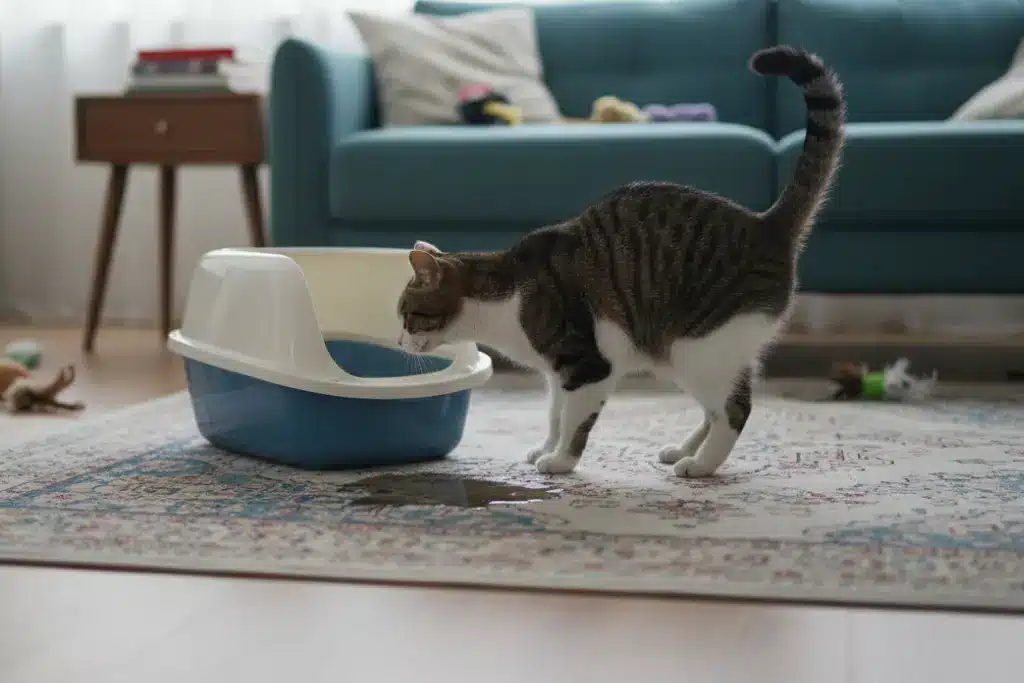
You’ve just found a wet spot on your duvet. Or maybe it’s the corner of the living room rug, the bathroom mat, or right next to the litter box itself.
Your cat has never done this before. You’re frustrated, confused, and maybe a little worried that something’s seriously wrong.
Here’s what we’ve learned after nearly 20 years of in-home cat sitting in Ottawa, Hamilton, and Mississauga: when a cat suddenly starts peeing outside the litter box, it’s almost never about defiance or spite. It’s communication.
Something has changed, medically, emotionally, or environmentally, and your cat is telling you the only way they know how.
If you’re worried about missing signs while you’re busy or away, consistent in-home care can help catch issues early.
First Things First, This Is Rarely About “Bad Behavior”
Roughly 10% of cats will eliminate outside the litter box at some point in their lives. That’s a significant number, and it points to how common, and how solvable, this issue really is.
What most people don’t realize is that 55–65% of feline lower urinary tract disease (FLUTD) cases are idiopathic, meaning there’s no clear physical cause. Stress, anxiety, and environmental triggers play a huge role.
Punishing your cat for this behaviour doesn’t just fail to solve the problem, it makes it worse. Cats don’t connect punishment with the act, especially if it happened hours earlier. What they do absorb is fear, which increases anxiety and can lead to more frequent urination outside the box.
Medical vs. Behavioral, How Professionals Tell the Difference
The first question you need to answer is whether this is a medical emergency or a stress response.
Medical red flags include:
- Blood in the urine
- Straining or crying while urinating
- Frequent trips to the litter box with little output
- Lethargy, hiding, or vocalization
Stress signals look different:
- Peeing on soft surfaces like beds or laundry
- Urinating near windows, doors, or new furniture
- Changes that coincide with travel, moving, or new pets
- Normal energy and appetite otherwise
In-home cat sitters often notice these patterns before owners do, simply because we’re observing your cat’s routine daily. We see the subtle shifts, less time in the litter box, more hiding, changes in posture or vocalization, that might not register if you’re only home in the evenings.
What Sitters Watch That Owners Often Miss
When we visit a cat dealing with litter box issues, we’re looking for context clues.
Is the cat avoiding the box entirely, or approaching it and then backing away? That can indicate pain or negative association.
Are they vocalizing more than usual, especially around bathroom time? That’s often a sign of discomfort.
Have they started hiding in places they don’t normally go, under beds, in closets, behind furniture? Stress and illness both trigger this behaviour.
We also track frequency. A cat who’s peeing small amounts multiple times a day is showing a very different pattern than one who has occasional accidents. That distinction matters when you’re deciding whether to book a vet appointment or adjust their environment.
Common Medical Causes of Litter Box Avoidance
Before you assume stress or behavioural issues, rule out medical problems. Cats are incredibly good at hiding pain, and urinary issues can escalate quickly if left untreated.
FLUTD, Cystitis & Urinary Crystals
Feline lower urinary tract disease is an umbrella term that covers infections, inflammation, crystals, and blockages.
Cystitis, inflammation of the bladder, is particularly common in indoor cats. It causes pain, urgency, and frequent trips to the litter box with little to show for it. Cats with cystitis often associate the litter box with pain, which drives them to pee elsewhere.
Urinary crystals form when your cat’s urine becomes too concentrated or their pH balance shifts. Certain diets, dehydration, and genetics all play a role. Left unchecked, crystals can lead to blockages, which are life-threatening emergencies.
The good news is that early veterinary care, usually involving diet changes, hydration support, and sometimes medication, can resolve most cases before they become serious.
When Peeing Outside the Box Is an Emergency
Some situations require immediate veterinary attention, not a wait-and-see approach.
Call your vet or an emergency clinic right away if your cat:
- Has blood in their urine
- Is straining repeatedly with no urine coming out
- Is crying, howling, or acting distressed while trying to urinate
- Shows signs of lethargy, vomiting, or loss of appetite
Male cats are at higher risk for urinary blockages, which can be fatal within 24–48 hours if untreated. Senior cats are also more vulnerable to complications from infections and inflammation.
In Ottawa, the Ottawa Animal Emergency and Specialty Hospital (OAESH) provides 24/7 care for urgent cases. Hamilton and Mississauga also have multiple veterinary emergency networks that can assess your cat quickly if something feels off.
Don’t wait. If you’re unsure whether it’s urgent, a quick phone call to your vet can give you clarity and peace of mind.
Stress, Anxiety & Environmental Triggers (The Overlooked Cause)
Here’s something that surprises a lot of cat owners: stress alone can trigger urinary issues, even in cats with no underlying medical condition.
Studies show that boarding increases anxiety in 30–50% of cats. That anxiety doesn’t just affect behaviour; it directly impacts the urinary tract. Routine disruption, unfamiliar environments, and separation from their primary person can all cause stress-induced cystitis or inappropriate elimination.
This is why we see so many cases of litter box avoidance immediately after a cat returns from boarding or when their owner has been travelling frequently.
Why Cats React So Strongly to Routine Changes
Cats are territorial animals. Their sense of safety is deeply tied to scent markers, predictable routines, and familiar spaces.
When you board your cat, they’re suddenly in a kennel that smells like dozens of other animals. Their food is served at different times. The sounds, lighting, and handling are all foreign. For anxious or sensitive cats, that’s overwhelming.
Even well-meaning changes at home, a new piece of furniture, rearranged litter boxes, a different brand of litter, can throw off a cat’s sense of security and trigger elimination outside the box.
Predictability matters. Cats thrive on routine, and when that routine is disrupted, stress manifests in physical ways.
Travel, New Sitters & Multi-Pet Homes
If you travel frequently or rely on different caregivers each time you’re away, your cat may struggle with inconsistency.
Multi-cat households add another layer of complexity. Cats compete for resources, including litter boxes. If one cat is bullying another away from the box, the subordinate cat will find somewhere else to go, usually a quiet, private spot like your bed or a corner of the basement.
The number of litter boxes matters too. The general rule is one box per cat, plus one extra. If you have three cats, you should have four boxes spread across different areas of your home.
When we care for multi-cat households, we watch for these dynamics. Who’s using which box? Is anyone avoiding certain areas? Are there signs of tension or bullying? Those observations help us, and you, figure out what’s really going on.
This is why Loving Paws focuses on routine-based, in-home care, especially for anxious or medically sensitive cats.
Ontario-Specific Factors That Make Litter Issues Worse
Living in Ontario brings unique environmental and lifestyle factors that can complicate litter box issues. Here’s what we see in each city.
Ottawa Winters & Apartment Living
Ottawa winters are long, cold, and isolating, for cats as much as people.
Indoor cats in apartments or condos near ByWard Market or other dense neighbourhoods face reduced activity levels during the winter months. Less movement means less stimulation, which can increase stress and lead to behavioural issues like inappropriate elimination.
Cold-related stress is also real. Cats feel temperature changes, especially if they’re near windows or doors. Drafts, dry air from heating systems, and reduced daylight all affect mood and comfort.
Condo living adds noise, hallway foot traffic, neighbouring pets, and construction. For sensitive cats, that constant low-level stress can tip them into litter box avoidance.
If you’re working long hours or travelling during winter, daily check-ins from a consistent caregiver ensure your cat’s staying active, hydrated, and emotionally stable.
Hamilton Humidity & Dense Housing
Hamilton summers can be humid, especially near the escarpment and around Bayfront Park. Humidity affects litter quality; it makes clumping litter sticky and clay-based litters more odorous faster.
If your cat is particular about cleanliness (and most are), a humid, smelly litter box will drive them to pee elsewhere.
Long-haired breeds like Persians and Ragdolls are especially prone to heat-related stress in Hamilton summers. Stress increases cortisol, which can trigger inflammation in the urinary tract even without infection.
We recommend scooping boxes twice daily during humid months and switching to low-dust, quick-clumping litters that handle moisture better.
Mississauga Travel & Pearson Airport Proximity
If you live near Toronto Pearson Airport in Mississauga, chances are you travel more frequently than the average pet owner. That means your cat’s routine gets disrupted more often.
Frequent travel creates cumulative stress. Even if your cat seems fine after one trip, repeated disruptions, especially with different caregivers each time, can lead to chronic anxiety and stress-related elimination issues.
Cats in Port Credit and along the Credit River trails are also more likely to encounter wildlife through windows, which can trigger territorial marking or anxiety-driven urination.
Maintaining the same caregiver every time you travel reduces that stress significantly. Familiarity matters. When your cat knows and trusts the person caring for them, their routine stays stable even when you’re away.
Myths vs Facts About Cats Peeing Outside the Litter Box
Let’s clear up some persistent misconceptions.
Myth: My cat is peeing on my bed out of spite.
Fact: Cats don’t think in terms of revenge. They’re responding to stress, pain, or a strong need to mix their scent with yours for comfort.
Myth: Spraying and inappropriate elimination are the same thing.
Fact: Spraying is territorial marking, usually on vertical surfaces. Inappropriate elimination is urinating or defecating outside the box, typically on horizontal surfaces. They have different causes and require different solutions.
Myth: If I ignore it, the behaviour will stop.
Fact: Ignoring litter box issues allows medical conditions to worsen and stress patterns to solidify. Early intervention is critical.
Myth: Cats who pee outside the box just need more discipline.
Fact: Punishment increases fear and anxiety, which makes the problem worse. What they need is medical care, environmental adjustments, or stress reduction.
Myth: Boarding is fine, cats don’t care where they are.
Fact: Many cats are deeply affected by boarding. The stress of unfamiliar surroundings, sounds, and smells can trigger urinary issues that last well beyond the boarding period.
How Professional In-Home Cat Sitting Helps Prevent Escalation
When you’re not home, you can’t see what’s happening. That’s the reality.
You won’t notice that your cat’s starting to avoid the litter box, or that they’re urinating more frequently, or that they’re hiding more than usual. By the time you get home and discover the problem, it’s already escalated.
Professional in-home cat sitters observe your cat daily. We see the early signs, subtle changes in behaviour, litter box usage, energy level, and vocalization.
At Loving Paws, every visit is documented in e-diary notes. If we notice anything unusual, fewer litter box visits, straining, blood, or accidents, we contact you immediately so you can consult your vet or make an appointment before the issue becomes serious.
That proactive monitoring has prevented countless emergency vet visits over the years. Catching a urinary issue on day one instead of day three can mean the difference between a simple diet change and a $2,000 blockage emergency.
In-home care isn’t just more comfortable, it’s safer for cats with stress-related urinary issues.
Why Choose Loving Paws & House Sitting for Anxious or Medical-Needs Cats
We’ve been caring for cats in Ottawa, Hamilton, and Mississauga since 2005. Over nearly 20 years, we’ve worked with anxious cats, senior cats, post-op recovery cases, and cats with chronic urinary issues.
Our team of 15+ caregivers is background-checked, insured, and bonded. We follow Pet Sitters International standards, which means health monitoring, stress reduction, and clear communication are built into every visit, not treated as optional extras.
We use the Ready-Key program for secure, seamless access to your home. Every visit includes photo updates and detailed e-diary notes that track litter box usage, appetite, behaviour, and any concerns.
If your cat has a history of FLUTD, anxiety, or inappropriate elimination, we document patterns and keep you informed daily. That level of attention simply isn’t possible with rotating app-based sitters or busy boarding facilities.
You’re not just hiring someone to scoop litter. You’re hiring trained professionals who know what to watch for and how to respond when something’s off.
FAQs: Litter Box Problems, Stress & In-Home Cat Care
Is my cat peeing outside the litter box because of stress or illness?
It could be either, or both. Start by ruling out medical causes with a vet visit. If bloodwork and a urinalysis come back clear, stress is the likely culprit. In-home care helps reduce stress by maintaining routine and familiarity.
How can I tell spraying from inappropriate elimination?
Spraying is usually done on vertical surfaces (walls, furniture legs) and involves a small amount of urine. Inappropriate elimination happens on horizontal surfaces (floors, beds, rugs) and involves larger amounts. Spraying is territorial; elimination is often medical or stress-related.
Can boarding cause urinary issues in cats?
Yes. Boarding stress can trigger idiopathic cystitis or stress-induced FLUTD, especially in cats who are already anxious or sensitive. Many cats develop litter box avoidance during or immediately after boarding stays.
How quickly should I see a vet?
If your cat is straining, has blood in their urine, or shows signs of distress, see a vet immediately. For less urgent cases, occasional accidents without other symptoms, monitor for 24–48 hours, then book an appointment if it continues.
Do sitters really notice health changes?
Professional sitters do. At Loving Paws, we’re trained to monitor litter box usage, appetite, energy, and behaviour. We document everything and reach out if we notice anything unusual. That daily observation catches issues early.
Is in-home sitting safer than boarding for cats?
For cats prone to stress, anxiety, or urinary issues, yes. In-home care eliminates the environmental stressors of boarding, unfamiliar sounds, smells, other animals, and routine disruption, all of which can trigger litter box problems.
Final Thoughts
You’re not a bad cat owner for missing early signs of litter box issues. Life is busy, and cats are masters at hiding discomfort.
But you don’t have to catch everything yourself. Consistent, professional in-home care gives you the peace of mind that someone’s watching for the subtle changes that matter, especially the ones that show up before a full-blown medical or behavioural crisis.
We’ve been doing this work in Ontario for nearly 20 years. We’ve seen what early intervention can prevent, and we’ve helped hundreds of cat owners avoid the stress, cost, and heartbreak of missed urinary issues.
Book trusted, in-home cat care with Loving Paws, so stress and medical issues don’t go unnoticed.