I’ve been caring for dogs in Ottawa, Hamilton, and Mississauga since 2005. Over nearly 20 years, I’ve seen hundreds of dogs react to fireworks, some mildly startled, others absolutely terrified.
But it wasn’t until I started deliberately tracking patterns that I realized just how predictable the fear response is, and more importantly, what actually helps.
This isn’t a controlled study. I’m not a researcher. But I am someone who’s been inside homes with anxious dogs during Canada Day in Ottawa, Victoria Day in Hamilton, and countless summer thunderstorms across the GTA. I’ve watched dogs tremble, bolt, hide, and panic. And I’ve also watched what calms them down.
Here’s what I’ve learned from those 50 dogs, and what you can do to help yours.
If fireworks already worry you, having calm, familiar in-home care can make all the difference.
Why Fireworks Terrify So Many Dogs (And Why It’s Getting Worse)
Roughly 50% of dogs are afraid of fireworks. That’s not a small subset, it’s half the dog population.
When you expand the scope to include all forms of noise anxiety, fireworks, thunderstorms, and construction, the number jumps to 74%. And approximately 41% of dogs have some form of diagnosable anxiety, a figure that’s increased by about 15% since the COVID-19 pandemic.
What I’ve noticed over the years is that fear doesn’t stay static. Dogs who are mildly nervous during their first fireworks experience often become more reactive with repeated exposure, especially if they’re left alone or not given proper support during those events.
Age plays a role, too. Senior dogs and rescue dogs with unknown histories tend to struggle more. But I’ve also seen young, well-socialized dogs develop noise phobias seemingly out of nowhere.
Fireworks vs Thunderstorms, Same Fear, Different Triggers
People often ask me if fireworks and thunderstorms trigger the same response. In many dogs, yes, but the triggers are slightly different.
Thunderstorms come with barometric pressure changes, static electricity, and sometimes wind or rain that dogs can sense well before the first crack of thunder. Fireworks are purely auditory and visual, but they’re unpredictable. Your dog doesn’t know when the next bang is coming, which creates a constant state of hyper-vigilance.
Some dogs who are fine during thunderstorms panic during fireworks, and vice versa. But the dogs who fear both? They’re usually the ones I’m most concerned about during holiday weekends.
Myth vs Fact: “They’ll Get Used to It”
One of the most persistent myths I hear is that if you just expose your dog to fireworks enough times, they’ll eventually get used to it.
That’s not how fear works, especially not unmanaged fear.
Repeated exposure without proper desensitization or counterconditioning doesn’t build tolerance. It builds sensitization. The fear gets worse, not better. I’ve seen dogs who were mildly anxious during their first Canada Day become completely unmanageable by their third or fourth year.
Research published in outlets like Psychology Today and the Smithsonian backs this up. Fear escalates when it’s not addressed. Ignoring it doesn’t make it go away.
What I Observed Watching 50 Dogs During Fireworks
When I started tracking patterns more deliberately, I wanted to see what the most common fear responses looked like and whether certain types of dogs struggled more than others.
Here’s what I found.
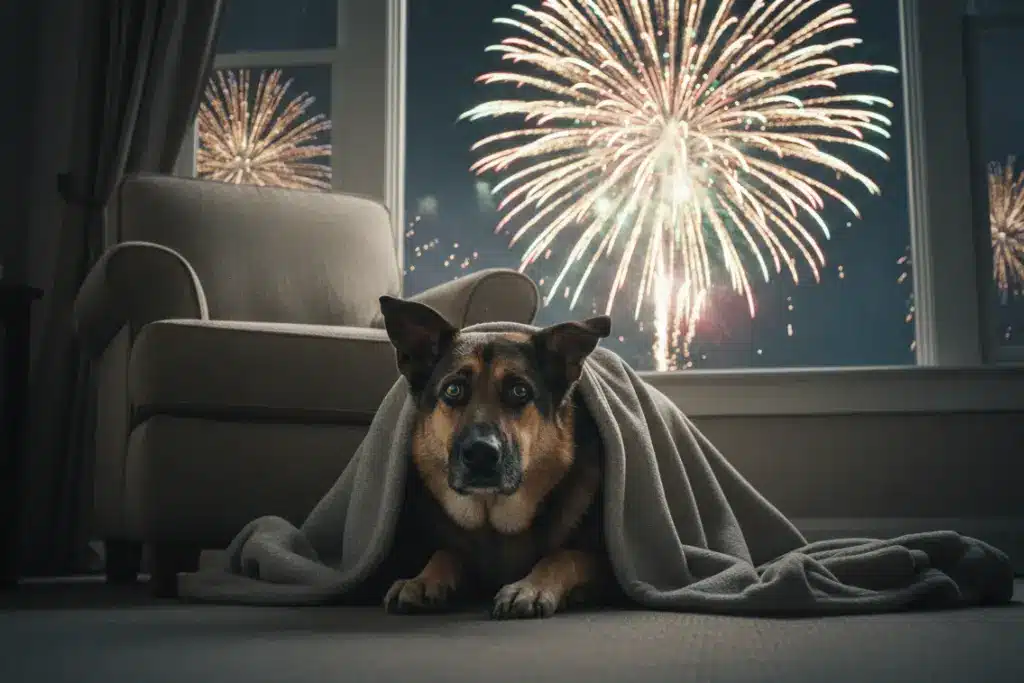
The most common behaviours were trembling, pacing, panting, and hiding. About 60% of the dogs I observed showed at least two of these signs. Another 20% tried to bolt, either toward their owner, into a closet, under furniture, or in a few cases, toward the door or window in an attempt to escape.
The dogs that vocalized, whining, barking, or howling, were usually the ones in the most distress. Vocalization isn’t always the first sign, but when it appears, it means the dog is reaching a breaking point.
What surprised me most was how quickly the fear escalated. A dog who seemed fine during the first few pops would be fully panicking within 10 minutes if the noise continued and no intervention happened.
The Dogs Who Struggled the Most
Certain types of dogs had a harder time than others.
Rescue dogs, especially those with unknown trauma histories, were significantly more reactive. I don’t always know what a rescue dog has been through, but I do know that fireworks seem to tap into something deep and primal for many of them.
Dogs in multi-pet households also struggled more, about 25% more than in single-dog homes. I think part of that is because anxiety feeds off other dogs’ energy. If one dog panics, the others pick up on it.
Senior dogs and dogs with existing medical conditions were more vulnerable too. Their stress tolerance is lower, and their ability to recover from a fear response takes longer.
The Common Mistakes Owners Didn’t Realize They Were Making
I’ve also noticed patterns in what doesn’t help, often because owners don’t realize they’re doing it.
The biggest mistake? Leaving dogs alone during peak fireworks times. I understand, people want to go out and enjoy Canada Day or Victoria Day. But leaving an anxious dog alone in an empty house during hours of fireworks is a recipe for panic, destruction, or escape attempts.
Boarding during fireworks is another one. I’ve had clients tell me they thought boarding would be safer because “someone’s there.” But boarding facilities are chaotic during holidays, lots of dogs, lots of noise, unfamiliar smells, and often minimal one-on-one attention. For an already anxious dog, that environment amplifies fear, not reduces it.
Inconsistent caregivers are also a problem. If your dog doesn’t know the person staying with them, they’re dealing with two stressors at once: fireworks and a stranger in their space.
What Actually Helps Dogs During Fireworks (Backed by Data)
I’ve tried a lot of different approaches over the years. Some work. Some don’t. Here’s what I’ve found to be most effective, backed by both my observations and research.
Routine + Familiar Environment (Most Effective)
The single most effective thing you can do for an anxious dog during fireworks is keep them in their own home with a familiar person.
Studies show that maintaining routine and familiar surroundings can reduce stress by 30–60% compared to boarding or leaving a dog with a stranger. I’ve seen this play out dozens of times. Dogs who stay home, eat at their normal time, and have someone they trust nearby are significantly calmer than dogs who are displaced.
Escape risk also drops dramatically when dogs are in a familiar environment. They know where the safe spots are, under the bed, in the closet, behind the couch. Boarding facilities and unfamiliar homes don’t offer that same sense of security.
Counterconditioning & Positive Reinforcement
Counterconditioning, pairing the scary thing (fireworks) with something positive (treats, play, calm attention), works. Research suggests it’s about 70% effective when applied correctly and consistently.
The key is timing. You can’t wait until your dog is already in full panic mode. You need to start before the fireworks begin, or at the very first sign of anxiety.
I use high-value treats, something the dog really loves, and pair every distant boom with a treat and calm praise. Over time, the dog starts to associate the noise with something good instead of something terrifying.
Calm modelling matters too. Dogs pick up on our energy. If I’m tense and hovering, the dog stays anxious. If I’m calm and matter-of-fact, the dog relaxes faster.
Calming Aids That Help (And Those That Don’t)
I’ve used a lot of calming aids over the years. Some help, some are hit-or-miss, and some do absolutely nothing.
What works for many dogs:
- Anxiety wraps or vests (like Thundershirts): These apply gentle, constant pressure that can calm some dogs. I’d say they help about 40–50% of the time.
- Pheromone diffusers (like Adaptil): These mimic the calming pheromones that mother dogs produce. They’re subtle, but I’ve seen them take the edge off for mildly anxious dogs.
- Probiotics designed for anxiety: Emerging research suggests gut health impacts anxiety levels. I’ve had a few clients report improvements after adding calming probiotics to their dog’s routine.
Gray area:
- CBD and calming supplements: These are popular, but regulations in Canada (CFIA) mean product quality and efficacy vary widely. Some dogs respond well, others don’t. Always consult your vet before trying anything new.
What doesn’t work:
- Ignoring the fear and hoping it goes away.
- Punishment or scolding for anxious behaviour.
- Leaving an anxious dog alone “to tough it out.”
Ontario Fireworks Are a Special Problem (Local Reality Check)
Fireworks aren’t just a summer annoyance in Ontario. They’re a predictable, recurring stressor tied to specific holidays and events, and each city has its own challenges.
Ottawa: Canada Day Fireworks & Condo Echo Chambers
Ottawa’s Canada Day fireworks are massive. If you live anywhere near Parliament Hill, ByWard Market, or along the river, you’re dealing with hours of noise on July 1st.
High-density neighbourhoods amplify the problem. Condos and apartment buildings echo and reverberate sound in ways that make fireworks feel closer and louder than they actually are. I’ve been in 10th-floor units where the bangs sounded like they were happening right outside the window.
The Ottawa Animal Emergency and Specialty Hospital (OAESH) sees a spike in anxiety-related emergencies every Canada Day, including dogs who’ve escaped, injured themselves trying to hide, or are in such severe distress that sedation is required.
If you’re in Ottawa and you know your dog struggles, don’t leave them alone on Canada Day. It’s one of the worst nights of the year for anxious dogs.
Hamilton: Victoria Day, Humidity & High-Energy Breeds
Victoria Day weekend in Hamilton brings fireworks, but it also brings heat and humidity. That combination worsens stress responses, especially in high-energy breeds like Labrador Retrievers, German Shepherds, and Border Collies.
The escarpment creates a natural echo chamber. Fireworks set off near Bayfront Park or along the waterfront bounce off the escarpment and carry across the city. Even if you’re not near the source, your dog is hearing it.
Humidity also affects dogs physically. They’re already panting from the heat, and when you add anxiety on top of that, they can overheat quickly. I’ve had to cool down more than a few dogs who were panting so hard from fear that they became dangerously warm.
If you’re in Hamilton during Victoria Day, make sure your dog has access to cool, quiet spaces and plenty of water.
Mississauga: Travel, Pearson Airport & Missed Warning Signs
Mississauga has a unique challenge: proximity to Toronto Pearson Airport means a lot of residents travel frequently. That often means dogs are left with caregivers, sometimes unfamiliar ones, during fireworks events.
I’ve worked with families in Port Credit and along the Credit River who didn’t realize their dog had severe fireworks anxiety until a sitter called them in a panic. The owners weren’t home, the dog was terrified, and no one had prepared for it.
Frequent travel also means cumulative stress. A dog who’s anxious during one fireworks event and then left again during the next is building a pattern of fear that gets harder to break.
Local sitters who understand your city’s noise patterns can intervene before panic escalates.
Why In-Home Pet Sitting Reduces Fireworks Anxiety
I can tell you from two decades of experience: in-home pet sitting is the most effective option for anxious dogs during fireworks. Not boarding, not apps, not leaving them alone.
Here’s why.
When a dog stays home, they’re in their safe space. They know the smells, the sounds, the layout. Their routine doesn’t change. Their food is in the same spot. Their bed is in the same corner. That stability alone reduces anxiety significantly.
When I care for a dog during fireworks, I’m not just “watching” them. I’m actively managing their environment and their emotional state.
Loving Paws Anxiety Management Protocols
We don’t wing it. We have specific protocols for anxious dogs during high-stress events like fireworks and thunderstorms.
Before the event, I work with owners to identify safe rooms, usually an interior room with fewer windows, where outside noise is dampest. I set up the space with the dog’s bed, favourite toys, water, and sometimes white noise or calming music.
During the event, I’m there. I’m monitoring behavioural indicators, panting, pacing, trembling, and hiding. I’m using counterconditioning techniques, offering treats and calm reassurance, and adjusting the environment as needed.
After each visit, I send detailed updates. Owners know exactly how their dog is doing, even if they’re hours away.
In-Home vs Boarding vs Apps (Rover / Pawshake)
Let’s be honest about the alternatives.
Boarding facilities during fireworks are chaotic. Multiple dogs, unfamiliar staff, noise, and stress. Escape attempts are common because dogs are desperate to find somewhere safe. I’ve heard too many stories of dogs injuring themselves trying to break out of kennels during fireworks.
App-based platforms like Rover or Pawshake connect you with individual sitters, but there’s no consistency, no vetting beyond basic profiles, and often no training in anxiety management. You’re rolling the dice on whether that person knows how to handle a terrified dog.
Professional in-home care with trained, consistent caregivers gives you oversight, accountability, and expertise. We’re insured, bonded, and experienced in managing anxiety. We know what works and what doesn’t.
For fireworks and storms, personalized in-home care outperforms kennels and gig apps.
Myths That Put Dogs at Risk During Fireworks
Let me clear up a few dangerous misconceptions I hear all the time.
Myth: Comforting a scared dog reinforces their fear.
Fact: You cannot reinforce fear with affection. Fear is an emotional response, not a behaviour. Comforting your dog helps them feel safe. Ignoring them makes it worse.
Myth: Fireworks are just harmless fun; dogs will be fine.
Fact: Fireworks are one of the leading causes of dogs escaping, injuring themselves, or developing chronic anxiety. They’re not harmless.
Myth: In-home pet sitting is unreliable during holidays.
Fact: Professional, bonded, insured sitters are more reliable than leaving your dog alone or boarding them in a chaotic facility. We’re accountable, trained, and experienced.
Myth: My dog will eventually get used to fireworks.
Fact: Unmanaged fear escalates over time. Without intervention, your dog’s anxiety will get worse, not better.
FAQ: Fireworks, Thunderstorms & Anxious Dogs
How do I know if my dog has a noise phobia?
If your dog shows signs of fear, trembling, pacing, hiding, panting, trying to escape, during loud noises like fireworks or thunderstorms, that’s noise phobia. It ranges from mild anxiety to full panic. If the behaviour is disrupting your dog’s quality of life or putting them at risk, talk to your vet.
Are fireworks worse than thunderstorms for dogs?
For some dogs, yes. Fireworks are unpredictable and purely man-made, which means dogs can’t anticipate them. Thunderstorms have environmental cues, pressure changes, wind, and static that some dogs can sense ahead of time. But many dogs fear both equally.
Should I leave my dog alone during fireworks?
No. If your dog has any history of anxiety, leaving them alone during fireworks is one of the worst things you can do. They’re more likely to panic, injure themselves, or try to escape. If you can’t be home, hire a trusted, professional sitter.
Is boarding safe for anxious dogs?
Not during fireworks. Boarding facilities are loud, chaotic, and unfamiliar. Dogs with anxiety often escalate in that environment. In-home care is safer and significantly less stressful.
Can sitters really prevent escapes?
Yes. Professional sitters are trained to secure homes, monitor doors and windows, and recognize early signs of panic before a dog tries to bolt. We’re also insured in case something does go wrong.
When should I talk to my vet about anxiety?
If your dog’s anxiety is severe, worsening, or affecting their quality of life, talk to your vet. There are medications, behavioural protocols, and supplements that can help. Don’t wait until your dog is in crisis.
Does pet insurance cover anxiety treatments?
Some policies do, especially if anxiety is diagnosed and treated by a vet. Check your policy for coverage on behavioural consultations, medications, and desensitization training.
Final Thoughts: Calm, Consistency, and Trusted Care Matter Most
You can’t eliminate fireworks. They’re part of living in Ontario, especially around Canada Day and Victoria Day.
But you can control how your dog experiences them.
The dogs I’ve seen do best during fireworks are the ones who stay home, stick to their routine, and have someone they trust nearby. That’s not luck, it’s preparation.
You don’t have to do it alone. Professional in-home care gives you peace of mind and gives your dog the calm, consistent support they need when the world outside feels terrifying.
We’ve been doing this work since 2005. We’ve helped hundreds of anxious dogs get through fireworks, thunderstorms, and other high-stress events safely and with as little trauma as possible.